Table of Contents
Introduction
Choosing a professional tray type cable tray manufacturer is critical for ensuring structural safety, long-term durability, and compliance with international standards. Tray type cable trays are widely used in power distribution, industrial automation, commercial buildings, data centers, and infrastructure projects where continuous cable support and enhanced protection are required.
A qualified manufacturer not only provides standard sizes but also offers engineering support, load calculation guidance, surface treatment options, and custom fabrication to meet project-specific requirements. When sourcing tray type cable trays for large-scale construction or industrial facilities, quality consistency and production capacity are just as important as price. Selecting a reputable manufacturer can significantly reduce installation risk and long-term maintenance costs.
What Defines a Professional Tray Type Cable Tray Manufacturer
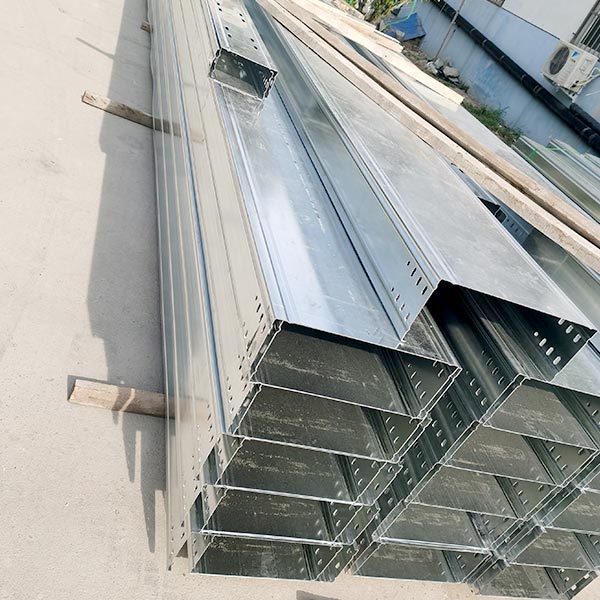
A reliable tray type cable tray manufacturer should meet several key criteria. First, strict material control. High-quality steel coils or stainless steel sheets must meet international mechanical strength standards to ensure load-bearing reliability. Second, precision fabrication. Modern roll forming, punching, and bending equipment ensures dimensional accuracy and structural consistency across batches. Third, corrosion-resistant surface treatment. Options such as pre-galvanized, hot-dip galvanized, stainless steel, and powder-coated finishes should be available depending on project environment. Fourth, load testing capability. Manufacturers should conduct deflection and load tests to verify performance under real installation conditions. Fifth, customization capacity. Non-standard widths, reinforced side rails, special thicknesses, and custom accessories should be available.
Additionally, professional manufacturers provide technical consultation and on-site installation guidance, helping project managers design an efficient cable routing system, calculate support spacing, and select suitable accessories for complex layouts.
Standard Product Specifications
Below is a reference table outlining common production capabilities of a professional tray type cable tray manufacturer.
| Specification Item | Typical Manufacturing Range |
|---|---|
| Width Range | 100 mm – 1000 mm |
| Side Rail Height | 50 mm – 150 mm |
| Steel Thickness | 1.0 mm – 2.5 mm |
| Length per Section | 2 m / 2.5 m / 3 m |
| Surface Treatment | Pre-Galvanized / Hot-Dip Galvanized / Stainless Steel / Powder Coated |
| Load Classification | Light Duty / Medium Duty / Heavy Duty |
| Custom Fabrication | Available upon request |
Actual performance depends on support span and installation conditions. Professional manufacturers provide load charts, engineering diagrams, and certificates of compliance to help engineers select the proper tray type cable tray for each application.
Manufacturing Process Overview
The production of tray type cable trays involves several controlled steps. Raw material inspection ensures compliance with mechanical and chemical composition requirements. Steel sheets are processed through automated roll forming lines to shape side rails and bottom panels. Perforation patterns are created using CNC punching machines for ventilation, drainage, and weight reduction. After forming, trays undergo surface treatment. For hot-dip galvanizing, products are immersed in molten zinc to provide thick corrosion-resistant coating. For powder coating, electrostatic spraying ensures uniform coverage. Final inspection includes dimensional checks, coating thickness testing, and load-bearing verification. Strict quality control throughout the process ensures structural integrity, consistent performance, and long service life.
Material Options and Application Scenarios
Pre-galvanized tray type cable trays are typically used in indoor commercial buildings where environmental exposure is limited. Hot-dip galvanized trays are recommended for outdoor installations, industrial plants, parking structures, and humid environments. Stainless steel tray type cable trays are suitable for chemical facilities, coastal areas, food processing plants, and highly corrosive environments. Powder-coated trays are often selected for architectural projects requiring aesthetic integration with building design.
Material selection should be based on environmental conditions, expected service life, chemical exposure, and project budget. A professional manufacturer can provide recommendations for coating type, thickness, and suitable accessories to optimize system longevity.

Load Capacity and Engineering Considerations
Load capacity depends on tray width, material thickness, side rail height, and support spacing. Reducing the span between supports increases load capacity and minimizes deflection. For heavy-duty power cables, reinforced designs and thicker materials are recommended. Engineers must consider total cable weight, future expansion allowance, and safety factors when designing the tray system. Thermal expansion, seismic conditions, and vibration exposure should also be accounted for in industrial applications. Many manufacturers provide pre-calculated load charts to simplify the design and support selection process.
Ventilation, Thermal Management, and Fire Safety
Although tray type cable trays provide more enclosure than ladder systems, perforated bottom designs allow adequate ventilation to prevent cable overheating. Proper airflow helps maintain signal integrity and prolong cable lifespan, particularly in data centers and control rooms with high-density installations. Optional covers improve fire containment, reduce flame spread, and provide protection against falling debris, which is critical in public areas and commercial buildings.
Installation Methods and Flexibility
Tray type cable trays can be installed in multiple configurations including ceiling suspension, wall mounting, floor support systems, and vertical risers. They are compatible with a full range of accessories such as horizontal bends, vertical elbows, tees, reducers, covers, and dividers, allowing flexible routing across complex building layouts. During installation, proper alignment and secure fastening are essential to maintain structural integrity. Grounding and bonding must comply with electrical codes to ensure system safety. Covers are recommended in dusty, outdoor, or high-traffic environments to enhance protection.
Applications of Tray Type Cable Tray
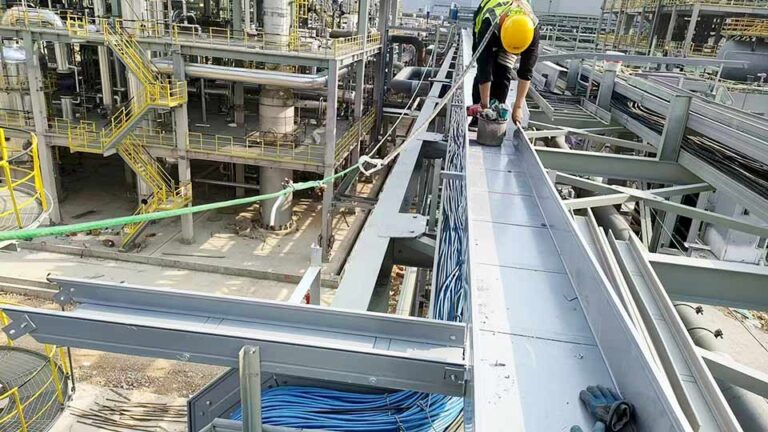
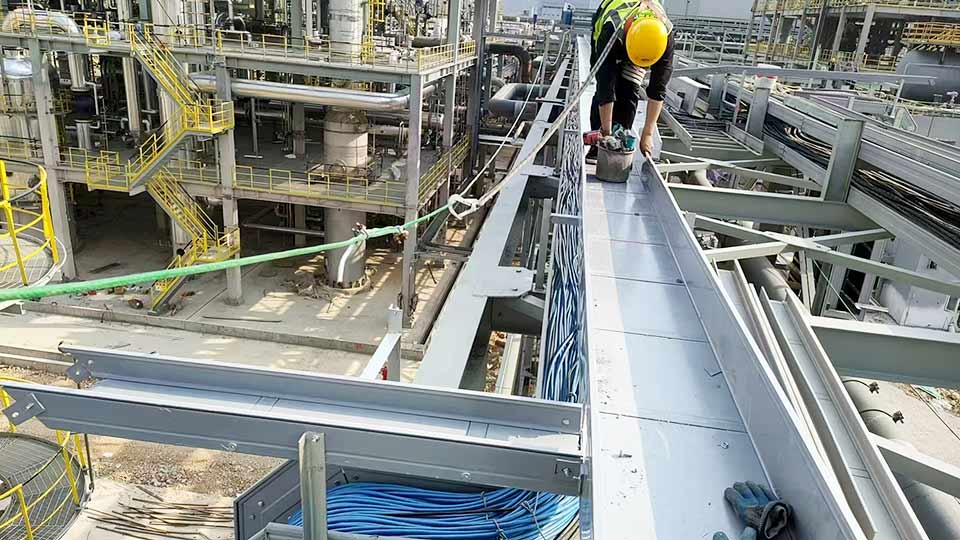
Tray type cable trays are extensively used in manufacturing plants to protect power and control cables, in commercial office buildings for lighting, HVAC, and communication networks, and in data centers for organized routing of power and structured cabling systems. They are also essential in transportation infrastructure such as airports, rail stations, and tunnels, as well as in energy facilities including substations and power plants. Their enclosed structure, mechanical strength, and customization flexibility make them suitable for almost any project requiring organized and protected cable management.
Tray Type vs Ladder Type Cable Tray
While ladder cable trays provide superior ventilation and higher load capacity for large power cables, tray type cable trays offer better containment and protection for smaller or multi-layer cable installations. Tray type systems are often preferred when cable density is high, environmental protection is required, or aesthetics are important in visible areas. Choosing the correct system depends on airflow requirements, cable size, environmental exposure, and project budget.
Maintenance and Long-Term Reliability
Routine inspections should include checking for corrosion, mechanical damage, loose fasteners, and proper cable organization. Cleaning accumulated dust and debris helps maintain airflow and reduce fire risk. When properly installed and maintained, tray type cable trays provide decades of reliable performance. Investing in high-quality materials and a reputable manufacturer reduces lifecycle costs and ensures compliance with safety standards.
FAQ
1. What is a tray type cable tray?
A tray type cable tray is a solid or perforated bottom cable management system providing continuous support and protection for electrical and communication cables.
2. Where are tray type cable trays commonly used?
They are used in industrial plants, commercial buildings, data centers, power distribution systems, and infrastructure projects requiring high-density cable routing.
3. How do I choose the right manufacturer?
Look for material quality, load testing capability, surface treatment options, customization ability, production capacity, and compliance with international standards.
4. Can tray type cable trays be customized?
Yes. Most professional manufacturers offer custom widths, reinforced side rails, special thicknesses, and accessory options for complex projects.
5. What materials are available?
Common materials include pre-galvanized steel, hot-dip galvanized steel, stainless steel, and powder-coated steel for various environmental conditions.